





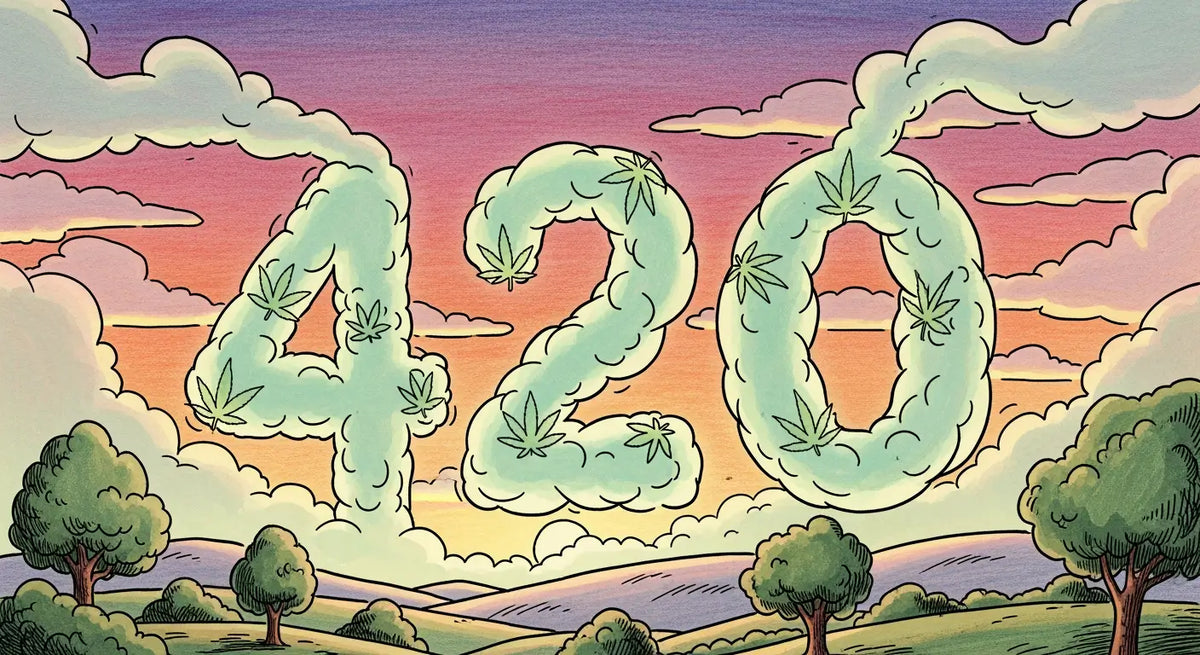
If you’ve gotten even a little into cannabis or CBD, you’ll sooner or later stumble across the number 420 – on T-shirts, Instagram posts or even as the name of events. It pops up everywhere, and anyone who knows it knows: this has something to do with weed. But what’s really behind this mysterious number? After this article, you’ll definitely be able to join the conversation.
The answer to 420 takes us back to sunny 1970s California, to five friends, a lost weed grow and a code that would eventually spread all over the world.
The five friends and the code
The story starts at San Rafael High School, about 30 minutes north of San Francisco. Five students – Steve Capper, Dave Reddix (Dave Stoner), Jeffrey Noel, Larry Schwartz and Mark Gravich – met up after class to start an adventure together.
A friend had told them that somewhere nearby there was an abandoned cannabis grow. The guys decided to go look for it. Their search meetup happened regularly. Always at the same time and at the same place.
Their meeting point: a statue of the French chemist Louis Pasteur on the school grounds. Their time: 4:20 p.m., so just after school. Their code: "420 Louis" – “Let’s meet at 4:20 at Louis.”
Sounds almost like the start of an old “Famous Five” audio story – just without a treasure map and pirate gold. Instead of barking dogs, the real five friends from California had weed, humor and a good dose of youthful rebellion.
How 420 became a global symbol
They called themselves “The Waldos”. Which instantly makes me think of the Waltons. But “The Waldos” had nothing to do with the Waltons. They chose the name because they were always hanging out by a wall (“the wall”).
Small spoiler: they never actually found the cannabis grow, but their code “420” stuck. When one of them said “420”, everyone knew: time to meet up, time to chill.
What started as a private joke accidentally turned into a cultural wave.
- One of the Waldos, Dave Reddix, later worked as a roadie for the legendary band Grateful Dead
- He kept using the term “420” there and the band picked it up.
- Before long, the band’s fans, the so‑called “Deadheads”, were hooked as well.
- They adopted the term.
- From there, the code spread like wildfire across California.
- Later across the whole USA.
In the 1990s, the magazine High Times came across the story and made it famous. They printed posters, articles and declared April 20 – i.e. 4/20 in the US date format – the unofficial cannabis holiday.
That made “420” official: a number with history, humor and a solid dose of freedom.
420 today – holiday, symbol, state of mind
By now, April 20 (4/20) is known worldwide as the day of cannabis culture. In cities like San Francisco, Vancouver, Berlin or London, thousands of people meet up every year to listen to music, have discussions or simply enjoy the vibe.
It’s long since become about more than just smoking. 420 stands for community, education, destigmatization and a conscious approach to cannabis. The number has become a symbol of a movement – peaceful, creative and always with a wink.
The time 4:20 has kept its place as well: when someone says, “It’s 4:20 somewhere”, they usually mean less the hands on the clock and more the mood – a moment to slow down, relax and take a breath.
420 in Germany
The number has long since found its place here too. For example, a cannabis festival called 420 is being planned in Hamburg. And around April 20 there are always smaller or larger events.
While in the past you needed codes and secret language to talk about cannabis, 420 today stands for openness and dialogue. There’s still a bit of rebellion left – but above all it’s about knowledge, awareness and responsibility.
From inside joke to movement
The exciting thing about 420 is that it came from something totally everyday – five students, one afternoon, one secret plan. No internet, no social media, just a code and an idea.
The Waldos themselves never intended to create a worldwide symbol. But that’s exactly what makes the story so likeable: it shows that culture often isn’t planned, it just happens. The recipe for it: friendship, fun and curiosity.
Maybe that’s also why 420 still works today. It’s not an aggressive symbol, but a quiet wink between people who don’t see weed as a taboo, but as part of culture, medicine and lifestyle.
What you really should know
420 – that’s three digits that now mean way more than just a time of day. They stand for a story that started with five friends who went looking for a plant and ended up creating a symbol instead. Today 420 is a reminder of tolerance, education and the fact that community can grow from small ideas.
So when someone shouts “Happy 420!” again on April 20, you can smile – and know that there’s more behind it than just a joke. It’s a piece of cannabis culture, a code that builds bridges between the past, the present and a movement that’s no longer living in the shadows.